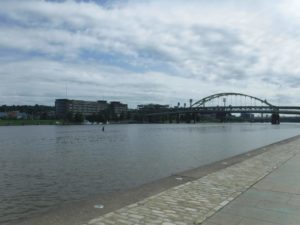
Photo by Rahja Watson – Downtown Pittsburgh River and Bridge View
The Truth About Pittsburgh’s Water
Story by: Rahja Watson – June 28, 2018
“I think clean water is a basic human right. I think that’s one of those things that we should all have access to, regardless of where you live, your ethnicity, or your income level,” said Chris Rolinson.
Pittsburgh, as a city with 3 major rivers, is centralized on the principles of water, its condition, and the things we use it for. As a community, being educated about water quality is essential to ensuring communication on its condition and a future of clean water. While there are both myths and facts about Pittsburgh’s water condition, seeking out the truth from experts and regulated data reveals a side the public often does not consider.
Rolinson, a professor in the School of Communication at Point Park University and also the coordinator of the Environmental Journalism Program shared his opinion on Pittsburgh’s water condition, why there are certain issues Pittsburgh communities face, and what plans of action can be taken to ensure a future of cleaner water.
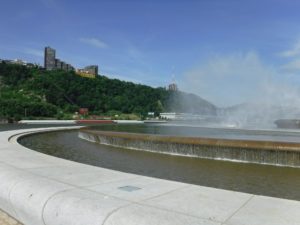
Photo by Rahja Watson – Image of Point State Park and Hillside
Rolinson began by stating his general opinion on water, as in his interactions with fountains, bathrooms, and drinking water, saying that he hasn’t noticed a difference in taste or smell in the 17 years he’s lived in the area. When asked about the general hysteria in the public about Pittsburgh’s water, Rolinson said, “I’ve looked at the reports, and from what I can tell, the water that leaves the plant, meets the standard of cleaning water.”
In accordance to this statement, from quality reports conducted by the Pittsburgh Water and Sewer Authority, the water in the city of Pittsburgh and the other boroughs that are distributed city water has not received chemical or bacterial violations since the beginning of annual water quality reports in 1999, with reports from the year 2000 not on file. The waterways serve a multitude of economic and recreational purposes, along with the reservoirs that complete a precise and complex filtering process for drinking water.
The professor continued by saying “Once, it (the water) gets into the system of pipes and networks, and makes their way to people’s houses, they interface with a lot of other areas.” Gaps in water system, leaks, and lead pipes can lead to contamination and higher levels of contamination in certain areas. There are often challenges with the city government in connection with replacing pipes, due to ownership and the cost.
According to Rolinson, this is common with multi-generation houses, in areas with high rentals, and in areas with low income residents.
“I think it should be an obligation for the city, the county, the state, and the federal government to resolve that lead pipe issue and come up with a methodology so that folks living in those houses have a way of getting that pipe fixed at a cost that is reasonable to them and the state, so that everybody takes ownership,” Rolinson said.
The professor believes that “as a human being you need water to live, you need clean water to live.” When facing issues with water purity, he believes in communication as a key factor for advising the situation and also the government taking on a role inside those communities. Actions to ensure more purewater have been and are being conducted in the community,such The Pittsburgh Safe Water Program, stricter regulations and observation for water plants and reservoirs, and the use of lead and other impurity filters.
“I think we need to remember,” Rolinson said, “we have an industrial backdrop and that we need to analyze that and not forget that it’s there and carry on and say, what can we do to strive to make health and clean water a priority while we develop.”