Pittsburgh: The City of Bicycles
By: Hannah Fierle
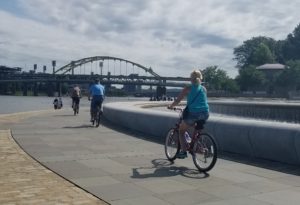
Photo by Hannah Fierle
With its multitude of bridges, vibrant cultural district, and picturesque skyline, Pittsburgh is a city worth exploring. It’s not surprising to see people riding their bikes all over the city, from the bustling streets of Downtown Pittsburgh to Point State Park’s sunny trails. For some, biking throughout Pittsburgh is a fun, leisurely activity to share with family and friends, while for others, it means a less costly and more environmentally friendly means of going to and from work. Regardless of their reason for cycling, Pittsburgh bike riders have a lively city chock full of a variety of unique trails and bikeways to enjoy.
Pittsburgh has grown into a very bike-friendly city since the turn of the century, thanks to the work of nonprofits such as Bike Pittsburgh, whose advocacy brought about things like bike lanes on the Birmingham Bridge, Forbes Avenue, and many other roads and bridges throughout Pittsburgh, as well as the installation of “blue lanes,” bike-friendly lanes that make crossing at intersections safer for cyclists. These measures, among others, led to a 37% increase in bike commuters in Pittsburgh from 2007 to 2008 according to Bike Pittsburgh.
For Pittsburghers without easy access to a bike of their own, another local nonprofit, Healthy Ride, offers a solution. Healthy Ride has established 50 stations across Pittsburgh stocked with over 500 bikes available to be rented through kiosks, and are currently working on a 2018 expansion that would increase the number of stations to 175 and bikes to 700. With inexpensive rates and a simple rental process, Healthy Ride provides a convenient way for anyone to get a bike for a period of time and take a spin around one or more of Pittsburgh’s unique neighborhoods.
Not only has Pittsburgh grown more bike-friendly, but bikes have come to benefit Pittsburgh as well. Pittsburgh’s air quality is among the worst in the country, according to the Post-Gazette. GASP (Group Against Smog and Pollution), a nonprofit that works throughout Southwestern Pennsylvania, has been able to use Pittsburgh cyclists and motorists to help them create a map of Pittsburgh’s pollution hotspots that residents can reference by attaching sensors to bikes and motorcycles that travel all over Pittsburgh.
Thanks to these measures and still many more, biking has taken off in Pittsburgh in recent years, with many opting to trade in their cars for bikes when it comes to traversing the city. Among these is Chris Rolinson, professor of Environmental Journalism at Point Park University. Rolinson taught his two children how to ride their bikes when they were only two and three years old, and has enjoyed biking with them in Pittsburgh in the years since. He also commutes to his job in Downtown Pittsburgh by bike. For Rolinson, biking to work “started off as a financial thing.” It’s significantly less costly than driving a car, saving Rolinson $11,000 a year. He also gets regular exercise by biking to work and helps the environment by burning less gasoline.
“One thing I don’t like about Pittsburgh’s trails is that they’re disconnected,” Rolinson stated, but he also recognized the impressive scale of Pittsburgh’s trails.
“You can ride all the way from Pittsburgh to Washington D.C.,” Rolinson said appreciatively. If local government were to work in conjunction with environmental groups and other nonprofits to “work together to link the greenways together” as Rolinson suggests, that would be the next step towards building a better, more connected Pittsburgh community.